
A tablet that lives in the room, and translates it every day.
Paired once to one classroom, counter or meeting room. Whoever picks it up sees two big choices: run the lesson or meeting to every phone, or hold a conversation across the table in two languages. The audience still brings nothing but their phones.
Runs on a 10-inch Android tablet or an iPad. Kits: a stand, a wireless microphone, and USB headsets for the table (in pilot).
A laptop and a volunteer work on Sunday. A classroom needs translation at 08:15, five days a week.
The laptop-and-microphone setup is right for a service or a conference. A room that runs every day needs something that is already there when the teacher walks in, works the same way for whoever picks it up, and cannot be taken apart by a curious pupil.
It belongs to the room, not to a person
An administrator pairs the tablet to one organization and one room with an eight-character code from the web console. Nobody signs in on it, so there is no password to forget and nothing to sign out of. The room keeps a permanent link and a printed QR code that work week after week.
Two big choices, in your own words
The home screen shows two large buttons in the vocabulary of your organization. A school sees Lesson and Student or parent conversation. A church sees Service or meeting and Conversation with a visitor. A municipality sees Meeting and Conversation with a resident.
A PIN to change anything
Leaving Station mode or changing a setting needs the administrator PIN. Home and Back cannot abandon a running lesson. On a managed tablet, Android's own navigation is removed while the station is active.
Updated from the console
Your tablets are listed in the web console by room. An update is queued from there and the tablet installs it itself. A tablet that goes missing is revoked from the console and stops working the next time it is opened; there is nothing personal on it to lose.

One tap, and the room is on every phone.
Tap Lesson, pick the class, and the QR code fills the screen. One Start microphone button, a level meter that proves sound is coming in, Pause while the class works on its own, End when it is over. Everyone in the room scans and gets voice or captions in their language on their own phone, in the browser, with no app.
- A preset per class — the teacher's language, the translation languages and add-ons such as raised hands, questions and slides, saved once and chosen from a pill beside the title
- The cost on the screen before every session — about what an hour costs for the languages chosen, and nothing while the microphone is paused
- Everything the platform does still applies — captions on the room screen, remote listeners, recordings if you switch them on, and transcripts afterwards
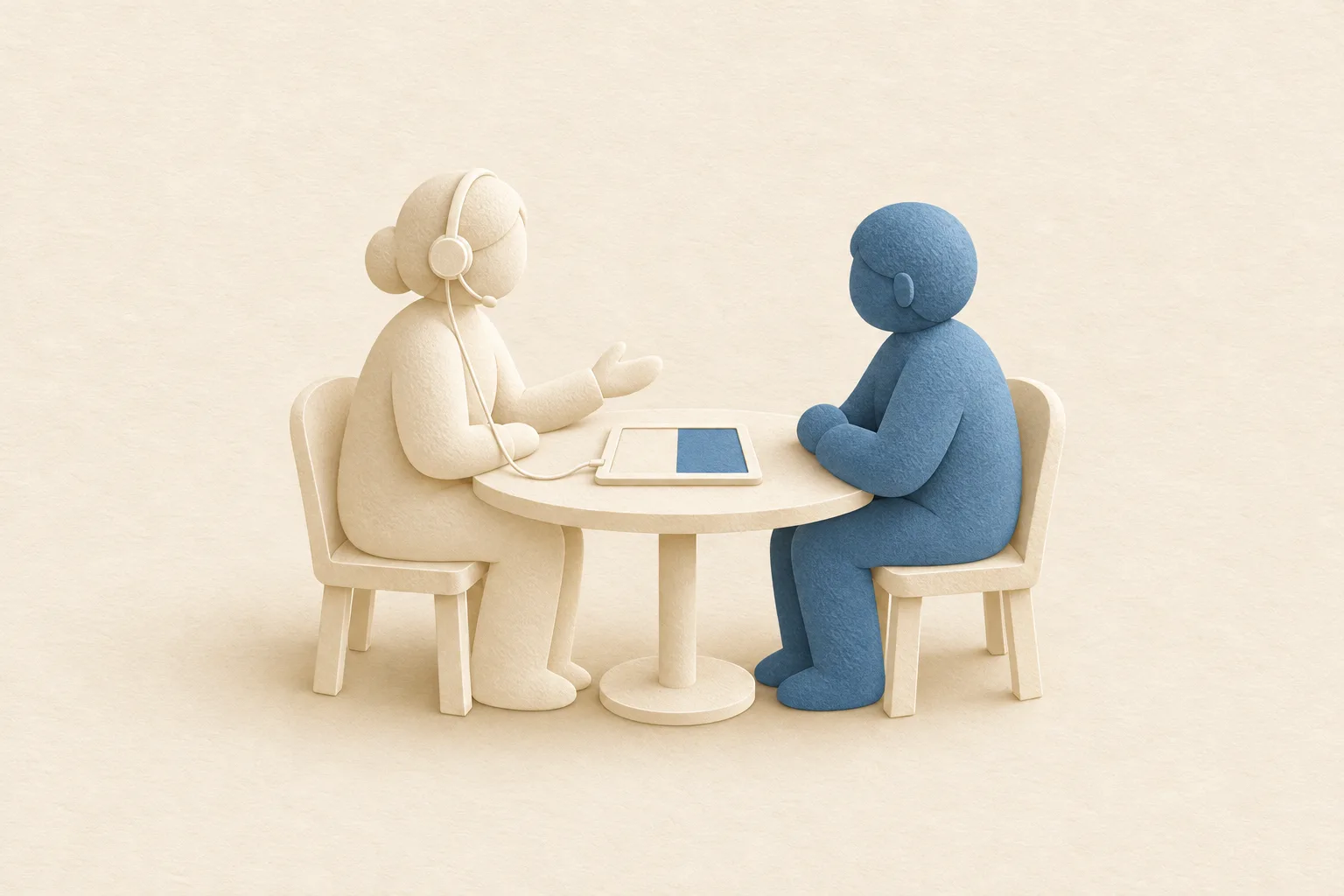
Two people, two languages, one table.
A parent meeting, a resident at the counter, a visitor after the service. Both people speak their own language and hear or read the other's, in turn, without a phone being passed back and forth. Three ways to run it, from the same station.
Shared tablet
The tablet lies flat between you. Each side reads the other's words in its own language in a split view and hears them through the tablet's speaker. Mute either language to text only, swap seats, pause, end.
Own phones
The tablet shows one QR code per language. Each person scans it with their own phone and listens or reads there, in the browser. Nothing is installed; the phone asks for its microphone.
USB headsets
Three or four people at the table each wear a USB headset on a hub, and each headset hears only its own language. Working in our lab and in pilot — ask us before you count on it.
Need to reach someone who is not in the room? From the Koine app, a translated phone call rings an ordinary number through Koine's own number: both people speak as normal and hear the other's answer translated inside the call. Available as an add-on on request. And a limit we state plainly: a medical, legal or contractual conversation still needs a qualified interpreter.
The rooms where language gets in the way every day.
The classroom
A preset per class, reading modes the teacher controls, pupils on their own phones or school iPads, and Feide sign-in where the school requires it.
The counter
A resident conversation at reception or in a caseworker's office during the day, and the council meeting to every phone in the evening, from the same tablet.
The foyer
The service to every phone on Sunday, and the conversation with a visitor at the door afterwards.
What is in the box, in plain terms.
Hardware is quoted per room. The software runs on the organization plan you already have, in the same language-hours as every other session.
The tablet and its stand
A 10-inch Android tablet, or an iPad you already own. The stand is made by us for it: upright at the front of the room for a lesson, flat on the table for a conversation. For an unattended room we recommend a managed Android tablet, so the station cannot be left without the PIN.
The wireless microphone kit
For a teacher or speaker who moves around the room, so the tablet can stay at the front. Available on request.
The USB headset kit
Three or four headsets and a hub for the table, each hearing only its own language. Working in our lab and in pilot — ask us before you count on it.
Paired in an afternoon. Ready every morning after.
Pair it to the room
In the web console, open the room under Locations and choose Pair a device. Type the eight-character code on the tablet, give it a name, and it belongs to that room.
Choose what it offers
Lessons and meetings, conversations, or both. Set the administrator PIN, the language the station speaks, and the language that is spoken into it.
Hand it over
Put it on its stand, print the room's QR code for the wall, and leave it. The next person to pick it up sees two buttons and nothing else.
Station questions.
Do the people who use it need an account?
No. An administrator pairs the tablet to the room once. The teacher, the receptionist or the volunteer who picks it up never signs in, and the people who scan the code never install anything or create anything.
Can we use a tablet we already have?
Yes — a 10-inch Android tablet or an iPad. For a room where the tablet is left unattended, we recommend a managed Android tablet: on that, Station mode removes Android's own navigation, so the station cannot be left without the PIN.
What does it cost?
The software is part of your organization plan and uses its language-hours: one per language, only while the microphone is on, nothing while paused. The hardware — the tablet, the stand and the wireless microphone kit — is quoted per room. The USB headset kit is in pilot and is not quoted yet. See pricing.
What if the tablet is lost or stolen?
Revoke it in the web console. It checks its credential every time it is opened, so from then on it reports that access was revoked and does nothing else. There is no account, no password and no personal data on it.
Does it record?
Only if you switch recording on. It is a separate switch, off by default, and a school's default is live-only. Set a session to temporary and no transcript line is written to our database at all.
Does it need Wi-Fi?
Yes — the room's Wi-Fi. The tablet sends the microphone to our servers and the translation comes back to every phone from there; the phones need a connection too. The station tells you when it cannot reach us, before anyone starts.
Is the headset kit available?
It works in our lab and is in pilot. Ask us and we will tell you where it stands.