One feed in. Every language out.
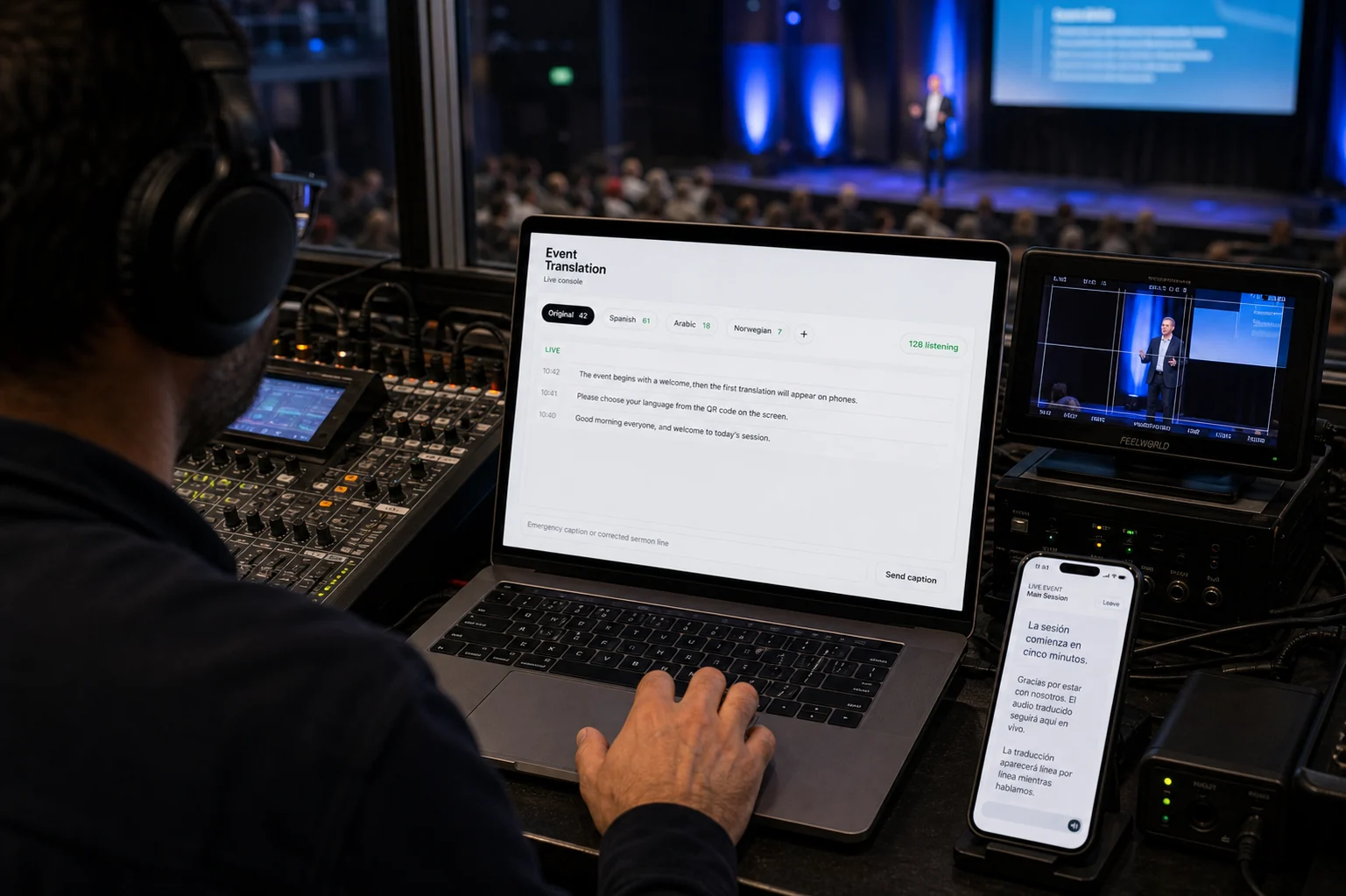
Koine takes a single clean source — a microphone, a soundboard feed, or a stream — and turns it into live translated voice and captions on every listener's phone. Each language is translated once and shared with everyone who picked it, so your cost follows languages, not crowd size.
15 minutes free on your own audio · No receivers, no per-listener fee
Hear it, or read it — listener's choice.
Every session runs both at once. Some people put in earbuds; others read along in silence. Nobody has to pick before they arrive.
Translated speech in their ear
A natural spoken voice in the listener's language, playing through whatever they already have in their ears. The voice follows the speaker's own delivery and pacing rather than reading a flat script.
- Works on any earbuds or headphones — nothing to pair with the venue
- About a second and a half behind the room, so it still feels live
- Listeners can also hear the raw room audio when they only need help hearing
A readable transcript, line by line
Translated text arrives as the speaker talks and keeps scrolling back, so a listener who looks up from their phone can catch the line they missed instead of losing the thread.
- Scroll back through everything said so far in the session
- Right-to-left languages such as Arabic render correctly
- Caption-only languages reach further than the voice list — useful for rarer languages
What a listener sees, line by line.
A short, looping preview of the listener view. Choose a setting:
In a conference or all-hands
Attendees follow the keynote in their own language.
Representative preview. In a real session, the platform translates your own live audio.
Whatever your room already runs.
You don't build anything new for Koine. One source per room, taken from the setup you already have.
A microphone
The simplest setup: a laptop and a decent mic near the speaker. Good enough for a classroom, a chapel, or a boardroom.
The soundboard
Take the same clean feed your speakers get. No room echo, no crosstalk, no chairs scraping — by far the best transcription quality.
A link or stream
Point the booth at a stream or video URL and it becomes the source — handy for rehearsals, testing, and sessions you don't run the audio for.
Better than everyone translating for themselves.
Consumer translation apps make each listener point their own phone at the room and hope. Sixty phones means sixty different mics, sixty rooms of echo, and sixty different guesses at what was just said.
- One source, translated once — the room hears the same sentence at the same time
- Run from the booth — the operator can see what the room is getting and fix it
- Cost follows languages, not crowd size — a room of 40 and a room of 400 open the same one Spanish lane
It can be told what the talk is about.
Names, places and specialist terms are where machine transcription usually slips. Give the session a title and any recurring names, and recognition is biased toward them before a word is spoken — so "Habakkuk" or a local street name stops coming out as something else.
Scripture, in their own Bible
When a passage is read aloud, the optional Church edition recognises it and shows the verse in each listener's own published Bible translation — not a machine paraphrase of your reading. See Koine for churches.
Common questions.
How far behind the speaker is it?
Around a second and a half for voice in typical conditions. It reads as live: listeners follow the speaker's gestures and the room's reactions without feeling out of step.
How many languages can run at once?
Up to three at once on the monthly plans, up to eight on Pro and on event passes. Each language costs one language-hour per hour it runs, so a two-hour service in three languages uses six language-hours regardless of how many people listen.
Do listeners need to install anything?
No. Joining is a link or a QR code and it opens in the phone's browser. The app is optional and adds notes, history and replay — see the Koine app.
What audio quality does it need?
Anything a person could comfortably understand. A soundboard feed is best; a good microphone near the speaker is fine. A phone on a table across a noisy hall is not.
Can listeners who aren't in the room join?
Yes — the same session works from anywhere on the same link. See remote & hybrid listeners.